How to Fence the Lord’s Table (Part 1) There is irony in fencing the Lord’s Table. What should be a joyous celebration, after due preparation of course, and a communion of believers with their risen Lord and with one another, is for . . . Continue reading →
2012 Archive
I Get Questions: How to Fence the Lord’s Table?
After the Central Valley Conference last month I promised to answer some of the questions submitted for the Q/A for which we didn’t have time. One of them asked essentially: whom should Reformed Churches admit to the Lord’s Table? There are three . . . Continue reading →
S-T-O-P Means Stop (or Does it?)
In 25 years of ministry one of the most profound changes I’ve seen is the growing inability and/or unwillingness of Americans to read texts according to the intent of the author. One of the major reasons for this change was the mutation . . . Continue reading →
Don’t Miss Out: The Whole Armor of God Jan 18-19 2013
Legend has it that J. I. Packer wrote Hot Tub Religion in reaction to an ad, published by a certain seminary in sunny San Diego county, touting the weather as a reason to think about enrolling. Well, at the risk of provoking another book . . . Continue reading →
There Is Spiritual Evil in the World
Since the shooting in Newtown, Connecticut there have been numerous explanations offered to account for what happened. Television reporters and commentators have spoken about evil. One said that “evil rolled through” Newtown. It does not take particular genius to see that mass . . . Continue reading →
Should We Stop Using the Expression “Reformed Faith”?
NB: The post below contains some friendly intramural discussion between colleagues. It’s what scholars do. It’s how we make progress in understanding, by tossing things back and forth and gaining clarity along the way. This sort of thing troubles some people so let . . . Continue reading →
On Humanizing and Dehumanizing
In The Abolition of Man C. S. Lewis worried about the effects of replacing sin and forgiveness with disease and therapy. His chief concern is that we would lose our humanity. This remains a great concern. Recently, one of the Supremes, not . . . Continue reading →
Office Hours: Bob Godfrey on Hebrews 3:7-4:13 (1)
Bob Godfrey is on Office Hours, this time to discuss Hebrews 3:7–4:13. We’re discussing how Hebrews treats the problem of apostasy and hypocrisy, Scripture, and the Sabbath. These are thorny questions but Bob is very helpful in walking us through them. I hope you’ll listen . . . Continue reading →
New: Riddlebarger on 1Corinthians
Kim Riddlebarger has a new commentary on 1Corinthians forthcoming in the Lectio Continua series. He’s got the information on the RB. The Lectio Continua series is a new exegetical, Reformed commentary, on Scripture, edited by Jon Payne, pastor of Grace PCA in . . . Continue reading →
Resources on Understanding the Differences Between the Lutheran and Reformed Traditions
A friend posted something on Twitter this AM that reminded me how little the two traditions understand each other today. In the 16th and 17th centuries our traditions were involved intense, frequent discussions and interaction and we understood each other more clearly . . . Continue reading →
Brothers We Are Not Perfectionists
Introduction In the doctrine of sanctification there are several errors to be avoided. First, let’s define our terms and understand what the basic biblical (and confessional Reformed) doctrine of sanctification is. The verb “to sanctify” is Latin. It is the word from . . . Continue reading →
Office Hours: Joel Kim on Hebrews 3:1-6
Joel Kim is back for another episode of Office Hours, this time to discuss Hebrews 3:1-6. Joel is Assistant Professor of New Testament at Westminster Seminary California. In this episode we discussed the superiority of Jesus to Moses and what it means to fix . . . Continue reading →
What Does Rome Mean By Papal Infallibility?
The impending arrival of the Bishop of Rome to Twitter (@Pontifex) has raised the question of papal infallibility in a new, late modern way. This seems like a good time to remind ourselves of what Rome teaches about the infallibility of papal . . . Continue reading →
Who Are the True Catholics? (5a): Justification
Part 4: Who are the True Catholics (4): Assurance of Salvation In theological terms, there were two principles of the sixteenth-century Protestant Reformation: the formal principle and the material principle. The first, the formal principle, was the doctrine that Scripture is the . . . Continue reading →
Protestants Looking For Authority Convert to Rome
As part of trend, which has been observed here since October 2009, a retired Episcopal minister, Larry Gipson, has become a Roman priest. Gipson was formerly the rector of the USA’s largest Episcopal church. He’s in process of becoming a Roman priest . . . Continue reading →
Would You Give Up the Means of Grace for 500 Million Dollars?
The recent Powerball lottery pay-off was 588 million dollars. This prompted the hosts of a Lincoln (Neb) sports-talk show, following Dan Patrick, to ask the following question: would you give up watching sports forever for $500,000,000? The guest to whom they asked . . . Continue reading →
Confessional Reformed Devotional Literature?
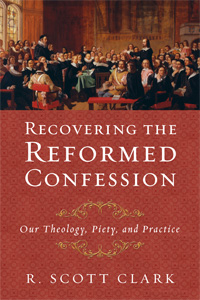
In Recovering the Reformed Confession I defined the “Reformed Confession” both narrowly (referring to the confessional documents adopted by the churches) and broadly referring to theology, piety, and practice in, with, and around the confessions themselves. Subsequent discussions here and elsewhere have . . . Continue reading →
Blame it on the Reformation: Hart Replies to Gregory
I have been in conversations before with Roman Catholics about a sacramental view of the universe and it still leaves be flummoxed. It is akin to the Reformed w-w phenomenon where Christianity is nothing unless it provides a comprehensive account of everything. . . . Continue reading →
Re-Thinking the Crusades
The History Channel reminds us that on this date in 1095, Pope Urban II ordered the First Crusade. Prior to 1979 it was more difficult than it is today to imagine such a thing, a leader of a world religion ordering a . . . Continue reading →
Reading Authors and Texts in Context
I was alerted to this new volume by Daniel Swift and wanted to let you know about it for two reasons: 1) It’s an interesting topic in which two groups of readers have an interesting, those interested in the history of worship . . . Continue reading →